
Please Don't Come to the Office: We only have 1,000 empty desks!
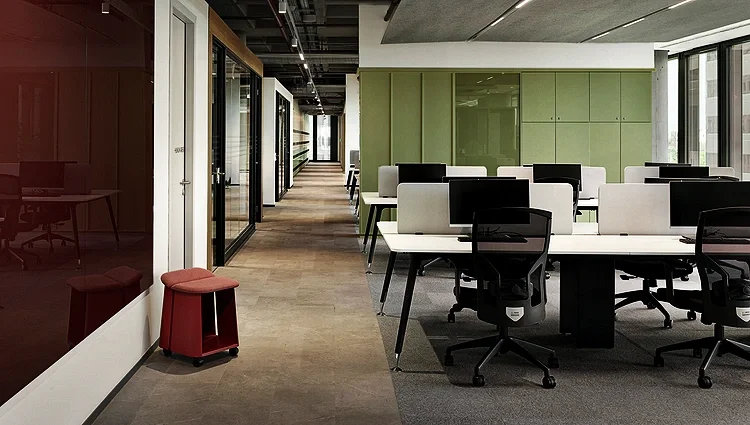
A major organization discovered they had over 1,000 unused desks at peak occupancy. The problem wasn't space—it was permission. And the missed opportunity to reset behaviors during reoccupation left them with an ironic solution: limiting office attendance in a workplace designed to bring people together.
The property manager was baffled. Every week brought new requests for additional desks. Department heads insisted their teams were squeezed for space. The math seemed simple: more people returning to the office meant more desks needed.
Then someone decided to actually count.
Over two weeks, facilities staff walked every floor of the campus, logging desk occupancy hourly. The results were stunning. Even at peak occupancy—that critical Tuesday morning when everyone converged on the office—over 1,000 desks sat empty.
The organization didn't have a space problem. It had a permission problem. And they'd missed a once-in-a-generation opportunity to solve it—a textbook example of what happens when change management is treated as an afterthought rather than a strategic priority.
The irony? Unable to expand their footprint and unable to get people to share space effectively, they eventually resorted to limiting how often people could come to the office. In an era when most organizations are desperately trying to encourage collaboration and office attendance, this organization was forced to do the opposite—all because they couldn't unlock the capacity they already had.
THE WINDOW THAT CLOSED
This workplace had spent years transitioning to Activity-Based Working. Before COVID, they had fewer desks than employees. The ratio worked because not everyone was in the office simultaneously, and the sharing protocols were well-established and actively managed.
Then COVID sent everyone home.
When reoccupation began, it was gradual. And here's the critical detail that any change management practitioner would recognize as a red flag: during that entire ramp-up period, there were more desks than people. Plenty of space. No competition. No need to share or follow those old protocols.
The behaviors that had taken years to establish simply evaporated. People found spots they liked. They left things there—photos, plants, charging cables, 6 spare pairs of shoes in their storage pedestal…... Some people moved furniture around so they could have 2 storage pedestals for their stuff. They came back to that same desk the next visit. Within months, psychological ownership was re-established.
By the time occupancy climbed back to pre-COVID levels, the activity-based workplace had quietly become a traditional assigned-desk environment again, except without the assignments.
THE ENTITLEMENT TRAP
There's a critical principle in change management that this organization learned the hard way: you need to establish the behaviors for your end state during the transition, not after you arrive.
When you allow people to adopt practices that aren't sustainable at full occupancy—even temporarily—those practices quickly transform from privileges into entitlements. This is classic change management theory: people don't resist change itself—they resist loss of entitlements. And loss is contextual, depending entirely on the reference point you establish.
Imagine if, during reoccupation, the organization had said: "Welcome back. We know there's plenty of space right now, but we're rebuilding our activity-based workplace. Here's how to book desks. Here's your locker. Here's why we're doing this even though it seems unnecessary today."
Some people would have grumbled. But they'd have understood the system from day one. The reference point would have been set correctly.
Instead, people returned to what felt like a personal desk environment. For months, that was their experience. It worked beautifully. Until it didn't.
When occupancy hit critical mass and the organization tried to reintroduce desk-sharing protocols, they weren't introducing a system—they were taking away something people had come to expect.
"I've been sitting here for 18 months, and now you're telling me it's not my desk?"
Hybrid Complication and Tribal Territories
Post-COVID brought another complexity: the video call explosion. Suddenly, half your team might be working from home on any given day. That quick question you'd ask by walking over to someone's desk? Now it's a Teams call. The workplace needed to support entirely different behaviours, with skyrocketing demand for enclosed spaces—meeting rooms, quiet rooms, phone booths.
Meanwhile, when property services analysed their manual count data, they discovered the empty desks weren't randomly distributed. They were clustered in specific neighbourhoods—informal zones that different departments had claimed as "theirs."
Marketing's area had spare desks. Finance's section had spare desks. Operations had whole rows that peaked at 60% occupancy. But employees in Operations didn't walk over to Finance's area when they couldn't find a spot. They just went home, or squeezed into a meeting room.
Because using a desk in another team's neighbourhood felt like trespassing.
The empty desks weren't invisible—they were visible but psychologically off-limits. At the moment of peak desk utilization, only 3,000 of 4,000 desks were occupied. Utilization was topping out at 75%—in a workplace where people were actively lobbying for more desks and meeting rooms were booked solid.
They had the capacity. They just couldn't access it.
The Bitter Irony
With a fixed footprint, limited budget for expansion, and an inability to get people to share space effectively, the organization faced an impossible situation. They couldn't add more buildings. They couldn't magically create more desks within their safety limits. And they couldn't break down the psychological barriers that kept 1,000 desks effectively invisible.
So they did the only thing left: they began implementing policies to limit how often people could come to the office.
While most organizations in 2024 are investing heavily in making offices more attractive and implementing return-to-office mandates, this organization was forced to do the opposite. They had to restrict office attendance because they couldn't unlock the capacity they already had.
It's the workplace equivalent of dying of thirst while surrounded by water you can't drink.
The whole point of maintaining a large campus was to enable collaboration and build culture. But poor change management during the critical reoccupation window had left them with a workplace that functioned at 75% capacity while feeling perpetually overcrowded.
The Real Lesson
Looking back with a change management lens, the organization needed to:
1. Introduce desk-booking systems and supporting protocols early, even when they seemed unnecessary. Change is always easier to implement when there's no perceived scarcity.
2. Reallocate space proactively to support new hybrid behaviors before demand became acute.
3. Communicate transparently: "We're designing for where we'll be in 18 months, not where we are today."
4. Manage neighborhood boundaries actively rather than letting them re-emerge organically.
The lesson for any organization planning workplace transformation:
Design for your end state. Implement the behaviors you'll need at full capacity during the transition, not after you arrive.
Because once people experience something as normal—even if you always intended it to be temporary—changing it back becomes exponentially harder. Miss that window, and you might find yourself in the absurd position of limiting office attendance in a workplace built for collaboration.
From a change management perspective, this case study demonstrates why workplace transformation can't be separated from the human and behavioral dimensions of change. You can design the perfect physical environment and have impeccable data—but if you don't manage the transition thoughtfully, you'll end up with outcomes that directly contradict your strategic intent.
The organization had more than 1,000 empty desks and insufficient meeting rooms, not because of poor space planning, but because they approached reoccupation as a facilities challenge rather than a change management opportunity.
The desks were empty. The meeting rooms were full. And they were forced to tell people to stay home…..