
Notes from the CoreNet Global Australia Summit - what everyone agreed on, and the question nobody quite asked.
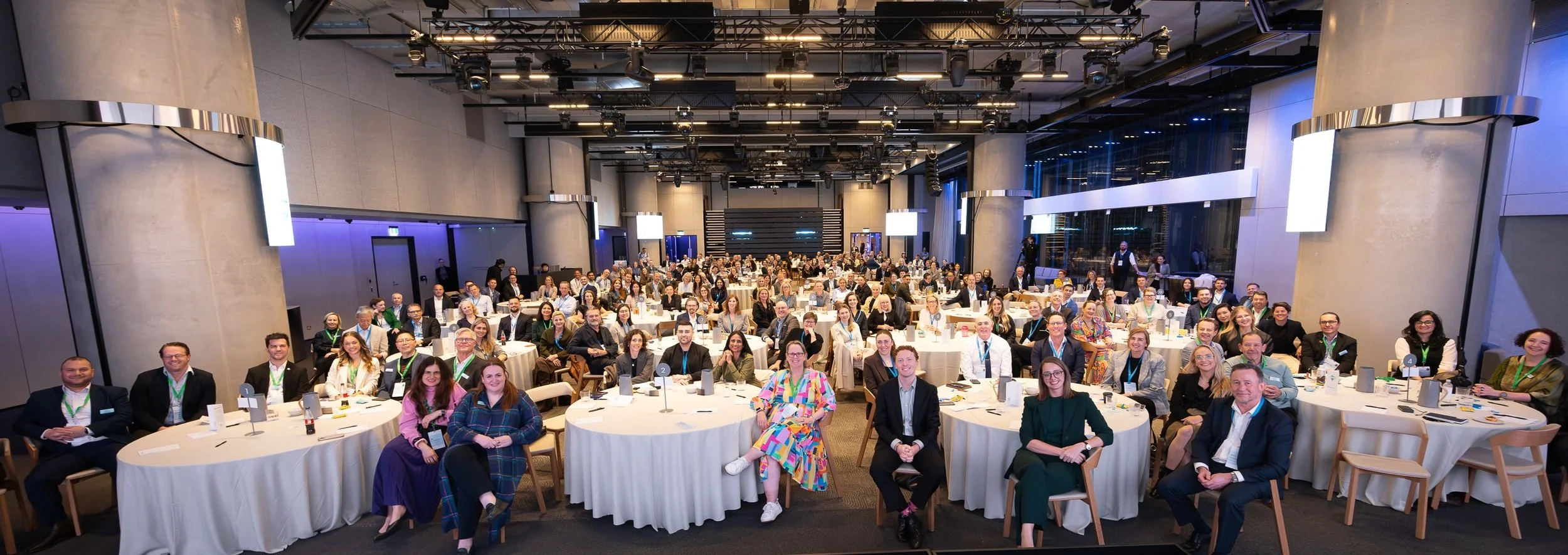
On August 19 we spent the day at the CoreNet Global Australia Summit in Sydney - 330 people, 137 organisations, and this year’s theme was “The Value Shift”. The room was the usual mix: the big agencies and developers, the designers and furniture people, and a decent number of actual occupiers - banks, energy companies, telcos, government. In other words, the people who commission, design, lease and run most of Australia’s workplaces were all in one room, being told value has shifted.
So had it? And more to the point - who’s doing the shifting?
What was the mainstream conversation?
Pretty much what you’d expect. Cushman & Wakefield’s Dr Dominic Brown gave a very good rundown of the supply problem: construction costs have run so far ahead of rents that in every Australian CBD it now costs more to build a building than the market will pay to occupy one. So almost nothing is being built, good space is getting scarce, and the premium on quality, location and height keeps growing. If you’re in the market for premium space in the core, your options can apparently be counted on one hand.
The other agreed positions: hybrid is done as a debate - attendance patterns haven’t really moved anywhere in the world for two or three years. And on AI, the room voted (by show of hands) for the sensible middle scenario - gradual adoption, augmentation not replacement, productivity gains arriving around 2028-30. All very comfortable. The herd was happy.
So where did it get uncomfortable?
In the research. Dr Libby Sander from Bond University presented a study of how people actually use offices - around 500 million observation data points, 15 offices, nine countries, three years. Not surveys, not co-design workshops (which decades of psychology tell us people don’t follow through on anyway) - actual observed behaviour. Some of what it found:
• Collaboration spaces were in use about 8% of the time - while roughly 60% of knowledge work is done alone. Her words, not ours: “we are overdesigning for collaboration”.
• Those sit-stand desks everyone specified? Even at peak times, more than half sit unused.
• The “buzz” turned out to be a Goldilocks story. People are drawn to other people - desks near someone already seated get chosen far more often, and nobody picks the empty, silent wing. But there’s a tipping point: push desk density and headcount-to-desk ratios too high and the pull towards other people actually weakens. The spontaneous bumping-into-each-other that dense offices are supposed to create is exactly what too much density kills.
• And from her lab - a causal study, not a correlation - ordinary open plan noise produced a 34% increase in measured physiological stress. People don’t get used to it. They just stop noticing.
Think about that for a second. The number one justification on almost every fitout business case of the last decade - we’re bringing people together to collaborate - and the biggest behavioural dataset ever assembled says we’ve been overbuilding for it.
Then there was the most telling moment of the day, and it wasn’t even on a slide. Dr Brown asked for a show of hands: who uses AI at least once a week? Nearly every hand went up. Who has AI actually embedded in their business - running real processes and tasks, not just tidying up emails? A handful. That gap is exactly why the AI productivity boom keeps not showing up in anyone’s numbers. Everyone has the tool. Almost nobody has done the work of changing how people work with it. Sound familiar? It should - it’s the same reason so many workplaces underperform their design.
And CSIRO’s Dr Claire Mason added an important observation. Her team looked at Australian businesses that brought AI into how they work, and compared them with similar businesses that didn’t. The result was the opposite of the robots-taking-jobs storyline: the businesses that adopted AI went on to advertise 36% more jobs - and ordinary jobs at that, not tech ones. They grew. The businesses where demand for people fell were the ones that didn’t adopt. So the risk isn’t the technology replacing your people. The risk is the competitor who puts it to work before you do.
The best talk wasn’t about workplace at all

The day closed with Sarah Walsh on the Matildas, and it was quietly the most useful session of the lot. For 20 years she was told women’s football failed the metrics that mattered - TV averages, reach, revenue. The turnaround came when Football Australia stopped chasing those numbers and did years of deliberate, unpopular, properly sequenced change instead: equal pay in 2019, real performance conditions, a parental policy everyone said would never work (until Katrina Gorry came back from having a baby fitter than ever). Her line of the day: “full stadiums are an output of the work - not the objective”. Four years later they beat every TV audience in Australian history.
Swap “full stadiums” for “full offices” and you have the best workplace advice given all day.
Our take
Put it all together and here’s what the day really said, even if nobody said it from the stage. You can now lease the best space in a generation, fill it with sensors, and put AI on every desktop. None of it changes what your people do on a Tuesday morning. The occupancy data tells you what they’re doing - it can’t tell you why, and it certainly can’t shift it. Mandates got bodies back in buildings, but attendance isn’t behaviour.
The value shift everyone came to talk about is really a behaviour shift - and shifting behaviour is a discipline, not a by-product. It’s deliberate work: deciding what you actually want people to do differently, designing the space and the technology around that, backing managers through the awkward middle weeks when the new ways haven’t stuck yet, and then measuring whether behaviour moved - not just whether people showed up.
That’s workplace strategy and change management doing what they’re supposed to do - one works out what “differently” should look like, the other makes it stick. The Matildas didn’t fill stadiums by building stadiums. They did the change work first, and the full stadiums followed. And in workplace you don’t fill offices by building offices - it’s by changing behaviours.
So a question for every occupier who was in the room (and everyone who wasn’t): if nobody works differently after the money is spent - what exactly did you buy?
More on that next month, when we look at what happens after move-in day.